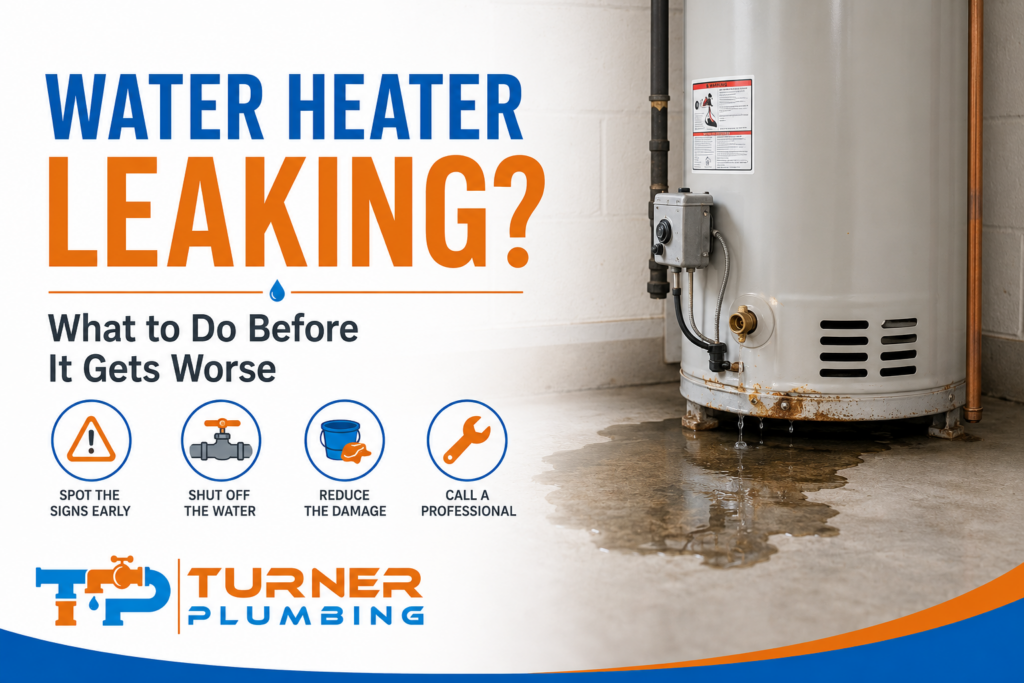

Turner Plumbing in Genoa, IL responds to water heater leak calls every week. A puddle under the water heater. A slow drip from a pipe connection. Water stains on the floor that weren’t there yesterday. Whatever form it takes, a leaking water heater needs attention immediately because the damage it causes gets worse by the hour.
Here’s how to identify where the leak is coming from, what to do right now to minimize damage, and whether repair or replacement is the right call.
What to Do Right Now
Before you diagnose anything, take these steps to prevent additional damage:
Turn off the power. For a gas water heater, turn the gas control valve to the “off” or “pilot” position. For an electric water heater, go to your breaker panel and flip the dedicated breaker for the water heater to off. Never work around a leaking water heater with the power on.
Turn off the cold water supply. There’s a shut-off valve on the cold water pipe above or next to the water heater. Turn it clockwise to close it. This stops water from flowing into the tank, which stops the leak from continuing. If the valve is seized or won’t turn, shut off the main water supply to the house.
Move belongings away from the water. Water heaters are usually in basements, utility closets, or garages where homeowners store boxes, documents, and seasonal items. Get everything out of the wet area immediately. Water damage to personal property accelerates fast, especially on cardboard, paper, and fabric.
Do not attempt to move the water heater. A standard 40 to 50 gallon tank weighs over 400 pounds when full. Moving it risks injury, pipe damage, and in gas units, gas line damage.
Where Is the Leak Coming From?
The source of the leak determines whether repair is possible or replacement is necessary. Dry the area around the base of the water heater with towels, then watch carefully to see where the water is reappearing.
Top Connections
Look at the cold water inlet and hot water outlet pipes on top of the water heater. If water is dripping from either connection point, the fitting may be loose or the supply line has failed. This is typically a repair. Your plumber can tighten the connections, replace supply lines, or re-seal the fittings without replacing the entire unit.
Temperature and Pressure Relief Valve
The T&P valve is located on the side or top of the tank with a discharge pipe running down toward the floor. This valve is a safety device that opens when tank pressure or temperature gets too high. If water is dripping from the T&P valve or its discharge pipe, it could mean the valve itself is faulty and needs replacement, or it could mean the water heater is generating excessive pressure due to a thermal expansion issue or a failing thermostat.
A leaking T&P valve should be inspected by a licensed plumber. The valve exists to prevent tank rupture, so simply capping it or tightening it is not a safe option. The underlying cause needs to be identified.
Drain Valve at the Bottom
The drain valve sits at the bottom of the tank and is used during maintenance flushing. If it’s dripping, it may not be fully closed, or the valve seat may be worn. Try closing it firmly by turning clockwise. If it still drips, the valve may need to be replaced, which is a straightforward repair.
The Tank Itself
This is the one you don’t want to hear, but it’s the most common cause of water heater leaks in units older than 8 years. If water is coming from the bottom of the tank where there are no valves or connections, the internal tank lining has corroded through and the tank itself has developed a crack or pinhole.
A leaking tank cannot be repaired. The corrosion is internal, progressive, and invisible from the outside until it breaches the outer shell. When the tank is leaking from the body, replacement is the only option.
Can It Be Repaired or Does It Need Replacement?
Usually repairable: Leaking inlet or outlet connections. A dripping T&P valve (valve replacement, not the tank). A weeping drain valve. A leaking supply line or flex connector. These are component repairs that your plumber can handle without replacing the water heater itself.
Replacement required: A tank that’s leaking from the body. Visible rust or corrosion on the outer shell. A unit that’s over 10 years old with any type of leak, because the repair cost approaches replacement cost and other components are likely near end of life as well.
If your water heater is showing other warning signs of failure alongside the leak, such as rumbling noises, rusty water, inconsistent temperature, or reduced hot water volume, replacement is almost always the right call. Repairing one component on a unit that’s failing across the board is throwing money at a losing cause.
How Long Can You Wait?
It depends on the severity. A slow drip from a valve connection can wait a day or two for a scheduled appointment, as long as you’ve shut off the water supply to the unit and placed a bucket or towels to catch the drip.
A tank that’s actively leaking from the body is an emergency. Tank leaks don’t stop on their own and they don’t slow down. They get worse. A small crack under internal pressure can open further at any time, and when it does, 40 to 50 gallons of water dumps onto your floor in minutes. If the tank body is leaking, call for emergency service.
Turner Plumbing provides water heater repair and replacement for homeowners in Genoa, IL and all surrounding communities. We diagnose the source of the leak, explain whether repair or replacement makes sense for your situation, and handle the work the same day whenever possible.
Preventing Water Heater Leaks
Most water heater leaks are preventable with basic annual maintenance. The two most important steps are flushing the tank annually to remove sediment that accelerates internal corrosion, and inspecting the anode rod every 3 to 5 years. The anode rod is a sacrificial metal rod inside the tank designed to corrode instead of the tank walls. Once the rod is depleted, the tank itself begins corroding.
The U.S. Department of Energy recommends annual maintenance on all residential water heaters to maximize lifespan and efficiency. A water heater that’s flushed and inspected annually can last 12 to 15 years. One that’s ignored typically fails in 8 to 10.
Knowing how many years your water heater should last helps you plan proactively. If your unit is approaching the end of its expected lifespan, scheduling a replacement on your timeline is always cheaper and less disruptive than dealing with a failure and emergency replacement.
Call Turner Plumbing
If your water heater is leaking in Genoa, Kingston, Sycamore, Burlington, or anywhere in DeKalb or McHenry County, Turner Plumbing is here to help. We respond to water heater emergencies and provide same-day replacement when needed. Call 630-246-4832 or visit our contact page to schedule service.